.jpg)
SpaceX Is Up 141% in the Last Six Months as IPO Valuation Estimates Approach $1.8 Trillion
Weekly Edition & Stock Spotlight
June 10, 2026
PM Insights, now part of MSCI, provides independent, market-driven data for Private Growth and Pre-IPO companies, delivering transparency and helping asset managers, banks, consultants, investors, and regulators understand trading conditions and risk in this dynamic market.
This report evaluates SpaceX’s performance and market positioning in the period leading up to its April 2026 IPO filing, which renewed investor focus on the commercial space and aerospace sector. As one of the most closely watched private space companies pursuing the public markets, SpaceX has attracted significant attention amid growing demand for satellite connectivity, launch services, and next-generation space infrastructure.
As a developer of reusable launch systems, satellite networks, and orbital transportation technologies, SpaceX has established itself as a leading player within the commercial space industry through its focus on launch efficiency, scalability, and vertical integration. The report examines the company’s operational momentum, competitive positioning, and market traction prior to its public market debut, providing insight into how investors may assess its long-term role within the evolving space economy.
Key Takeaways
- 90-Day Stock Performance: SpaceX ranked 1st among the ten most active private-market companies and delivered positive returns over the past 90 days
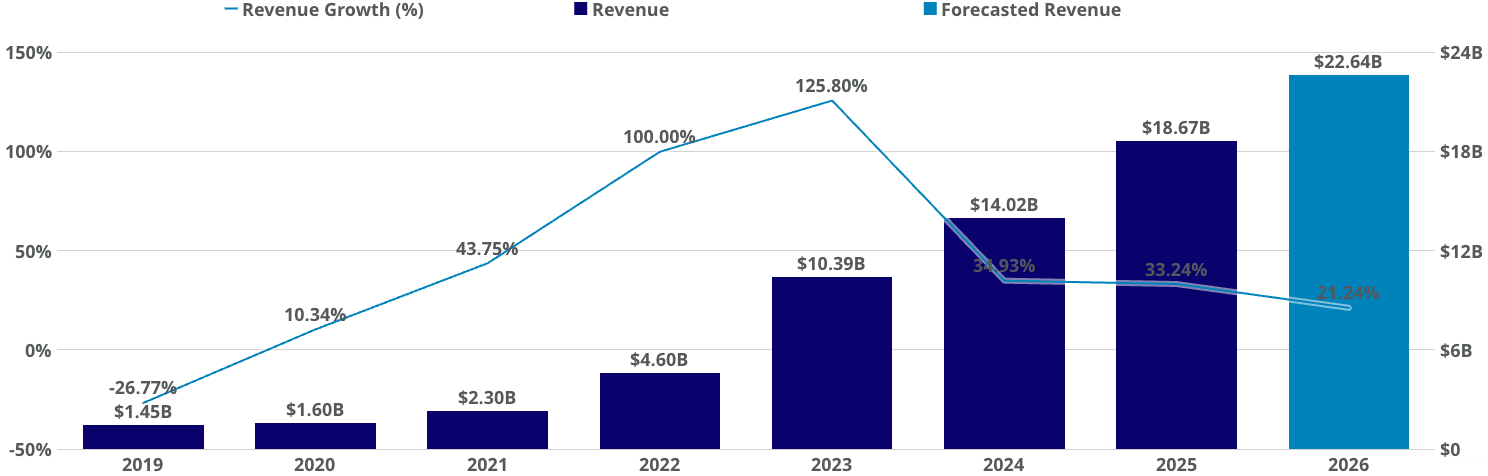
- Revenue Expansion: SpaceX's revenue grew 33.24% year-over-year to $18.67 billion in 2025
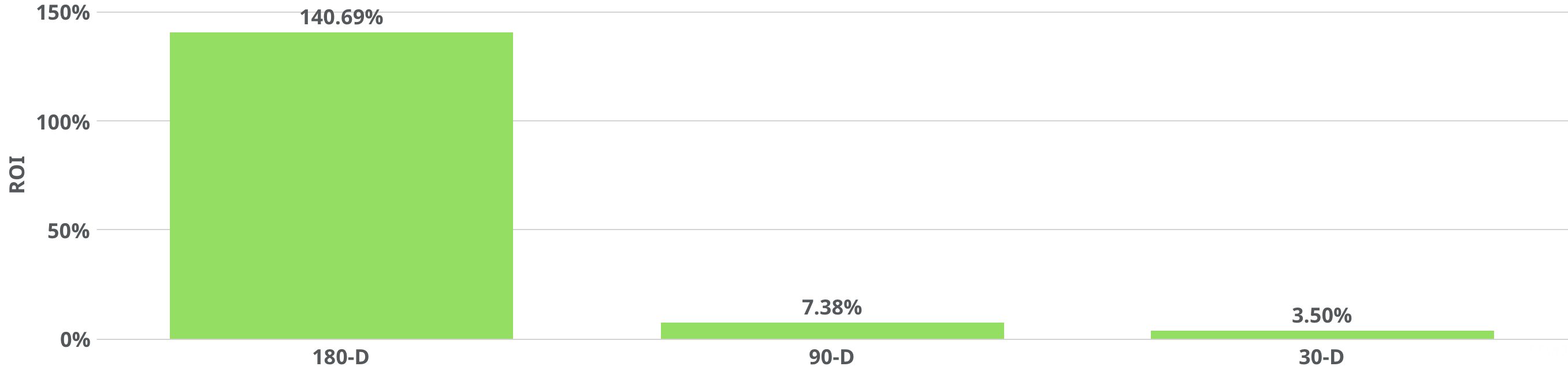
- ROI Momentum: SpaceX delivered strong gains of +140.69%, +7.38%, and +3.5% over the past 180 days, 90 days, and 30 days respectively
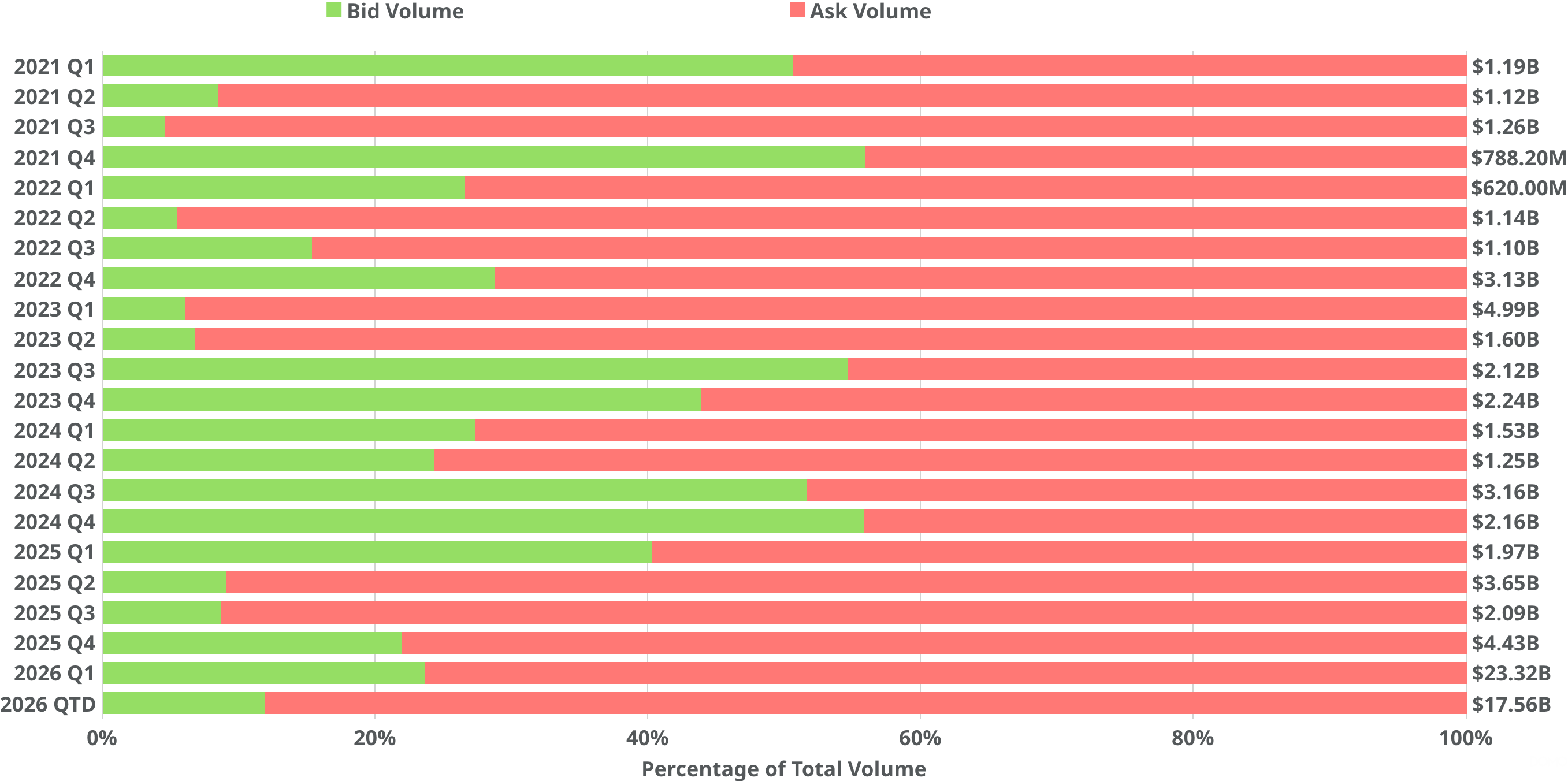
- Peak Bid-Ask Volume: SpaceX's bid-ask volume peaked at $23.32 billion in 2026 Q1
Past performance, whether actual, backtested or simulated, is no indication or guarantee of future performance.

ROI Private & Public
|| ROI from Dec 31, 2025 until June 8, 2026.
<row>
<col>
.png)
</col>
<col>
.png)
</col>
</row>
The PM50 Growth tracks the performance of the 50 most active private names observed in the secondary market. It is an equal-weighted index, rebalanced on a monthly basis.
This rebalancing of constituents over time gives way for more active names to participate in what we observe as "market performance," and in a more appropriate manner than static selections and weightings criteria.
Most Active Names Performance Across All Sectors
Data as of June 8, 2026.
90D Return △ - Trend of return on composite price
90D % △ - Change in composite price in terms of percentage
.png)
Price (USD) estimated based on secondary market activity observed by MSCI Private Company Insights. Valuation is estimated based on said price and share count from state filings and/or news in the public domain. Note that share count in calculations may change as new filing documents are obtained.
Stock Spotlight - SpaceX
.png)
Sectors
aerospace defense transportation
Headquarters
Hawthorne, California, U.S.
CEO
Elon Reeve Musk
“Making life multiplanetary”
SpaceX is an aerospace manufacturer and satellite communications company founded in 2002 by Elon Musk, headquartered in Hawthorne, California. The company designs, manufactures, and launches advanced rockets and spacecraft, with the ultimate goal of enabling people to live on other planets. Today, SpaceX sits at the center of three interconnected markets: launch services anchored by the reusable Falcon 9 and the next-generation Starship program, satellite broadband through Starlink, and government-focused secure communications through Starshield.
The company confidentially filed for an IPO on April 1, 2026, with reports indicating a potential offering price of approximately $135 per share, and an implied valuation of $1.77 trillion, which would rank it among the largest public listings in recent years.
Business Model
SpaceX operates a vertically integrated flywheel in which launch services revenue funds the development of progressively cheaper and more capable reusable spacecraft, which in turn enable new high-margin recurring revenue streams. Launch services revenue funds R&D for increasingly advanced reusable spacecraft, which then enables cheaper launches and the deployment of new revenue streams like Starlink, now the company's core profit center. On the launch side, the company sells missions to NASA, the Pentagon, and commercial satellite operators, with a standard commercial Falcon 9 launch priced at roughly $60 million and Falcon Heavy launches at about $125 million each.
Starlink monetizes through a multi-tiered subscription model, spanning consumer, enterprise, and government segments, with premium offerings such as Maritime at $250 per month and Aviation at $25,000 per month driving higher average revenue per user, alongside partnerships with airlines like United and mobile carriers like T-Mobile for direct-to-cell connectivity.
The cost structure is held down by deep vertical integration: SpaceX produces roughly 70% of Falcon 9 in-house at its Hawthorne facility and controls its entire value chain from rocket design and production to launch operations, ground station networks, and its own spaceports in Texas and Florida, allowing it to price launches based on the next-best alternative rather than its own operating costs, which supports healthy margins.
Scale and Growth
- Scale & Volume: 165 orbital launches in 2025, a sixth consecutive annual record
- Market Share: ~85% of U.S. orbital launches in 2025
- Customer Base: Starlink surpassed 10 million active customers across 160 countries, territories and markets by February 2026, up from 4.6M at the end of 2024
- Profitability: Starlink generated $4.4 billion of operating revenue in 2025, the company's core profit center
- Government Tailwind: $2 billion Pentagon contract under the Golden Dome program, potentially fielding up to 600 satellites
- Capacity Expansion: Federal Aviation Administration authorization to increase Starship cadence at Starbase, Texas from 5 to up to 25 launches per year
<row>
<col>
Targeted Impact
SpaceX aims to facilitate human life on Mars and transform space access to secure humanity's survival and a multiplanetary future.
</col>
<col>
.png)
</col>
<col>
What Comes Next?
SpaceX is pursuing a potential 2026 IPO while continuing development of Starship and expansion of Starlink.
</col>
</row>
<row>
<col>
.png)
</col>
<col>
Who will benefit?
Satellite operators, government agencies, commercial space ventures, and scientific researchers benefit from SpaceX innovations.
</col>
<col>
.png)
</col>
</row>
SpaceX's Timeline
.png)
SpaceX's Competitive Landscape by Similarity and Market Cap
The chart below shows SpaceX’s peer companies. Bubble size represents each company’s valuation based on MSCI Private Company Insights data as of June 8, 2026, while line width indicates similarity to SpaceX. Thicker lines represent a higher degree of similarity.
.png)
Source: Syntax Data. Classification data as of April 8, 2026.
Prominent News
Sen. Warren calls on SEC to delay SpaceX IPO, June 10, 2026 - According to a letter shared with CNBC, Sen. Elizabeth Warren urged the SEC to delay SpaceX’s forthcoming IPO over concerns about its valuation and governance structure. Read the full article.
SpaceX Faces A Crucial Launch Test Ahead Of Its IPO, May 22, 2026 - SpaceX faces a critical Starship launch test that could influence investor confidence following the company’s IPO filing. Read the full article.
Google in talks with SpaceX for Suncatcher orbital data center project, May 12, 2026 - Google and SpaceX discuss a potential collaboration on orbital data centers as both companies explore space-based infrastructure to support growing computing and AI demand. Read the full article.
Revenue
The graph below displays the revenue and revenue growth of SpaceX 2019 to 2026.
- SpaceX's revenue grew 33.24% year-over-year to $18.67 billion in 2025 with 2026 revenue forecasted at $22.64 billion
Return on Investment (ROI)
The graph below displays SpaceX's ROI over the past 90, 60, and 30 days, computed as of June 8, 2026.
- 180D: ↑ +140.69% since December 11, 2025
- 90D: ↑ +7.38% since March 11, 2026
- 30D: ↑ +3.5% since May 10, 2026
Valuation in USD
- Acquisition: SpaceX acquired xAI on February 2, 2026, in a deal that valued the company at $1.25 trillion
- Secondary Market Valuation: $1.48 trillion on June 8, 2026, according to MSCI Private Company Insights
<row>
<card>
Acquisition Valuation
<span class="date">2026-02-02</span>
<span class="value">$1.25T</span>
</card>
<card>
Secondary Market Valuation
<span class="date">2026-06-08</span>
<span class="value">$1.48T</span>
</card>
<card>
Estimated IPO Valuation
<span class="date">2026-06-12</span>
<span class="value">$1.77T<span>
</card>
</row>
Quarterly Bid-to-Ask Volume Ratio
MSCI Private Company Insights presents the quarterly bid-to-ask volume ratio of SpaceX from 2021 Q1 to 2026 QTD. The stacked bar chart below shows total quarterly bid and ask volumes alongside their relative ratios, illustrating market activity.
- Highest volume: $23.32 billion in 2026 Q1
- Lowest volume: $620 million in 2022 Q1
- 2026 QTD volume: $17.56 billion
Volatility of Composite Price
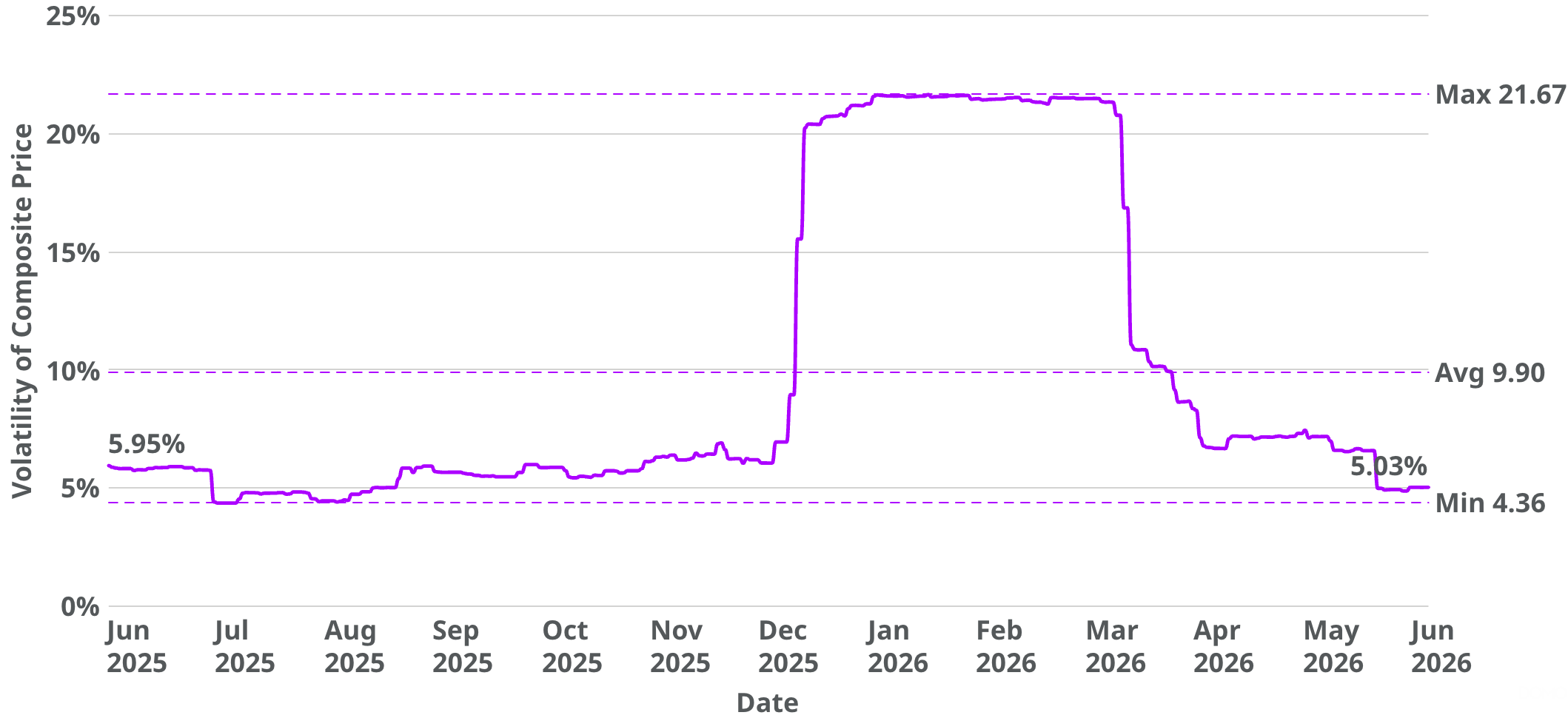
The volatility of the composite price is calculated based on price movements within a 90-day rolling window ending on each respective date. The graph below illustrates the trend in volatility of composite price for SpaceX for a one-year period from June 9, 2025 until June 8, 2026.
- Volatility began the period at 5.97%, showing minor fluctuations before falling to a low of 4.36% in early July
- It then climbed steadily to 8.95% by mid-December before rising sharply to 20.26%
- Volatility reached a period high of 21.67% in mid-January 2026 and remained around that level until mid-March 2026
- It then declined sharply to 11.07%, followed by a gradual decrease through the remainder of the period
- The period ended with volatility at 5%
SpaceX's Private Comparables
MSCI Private Company Insights highlights two private companies, all active as of June 8, 2026, that are close competitors of SpaceX. These companies either develop advanced launch and spacecraft technologies or provide orbital infrastructure and in-space manufacturing capabilities that support satellite deployment, space operations, and commercial space missions.
Change in Valuation
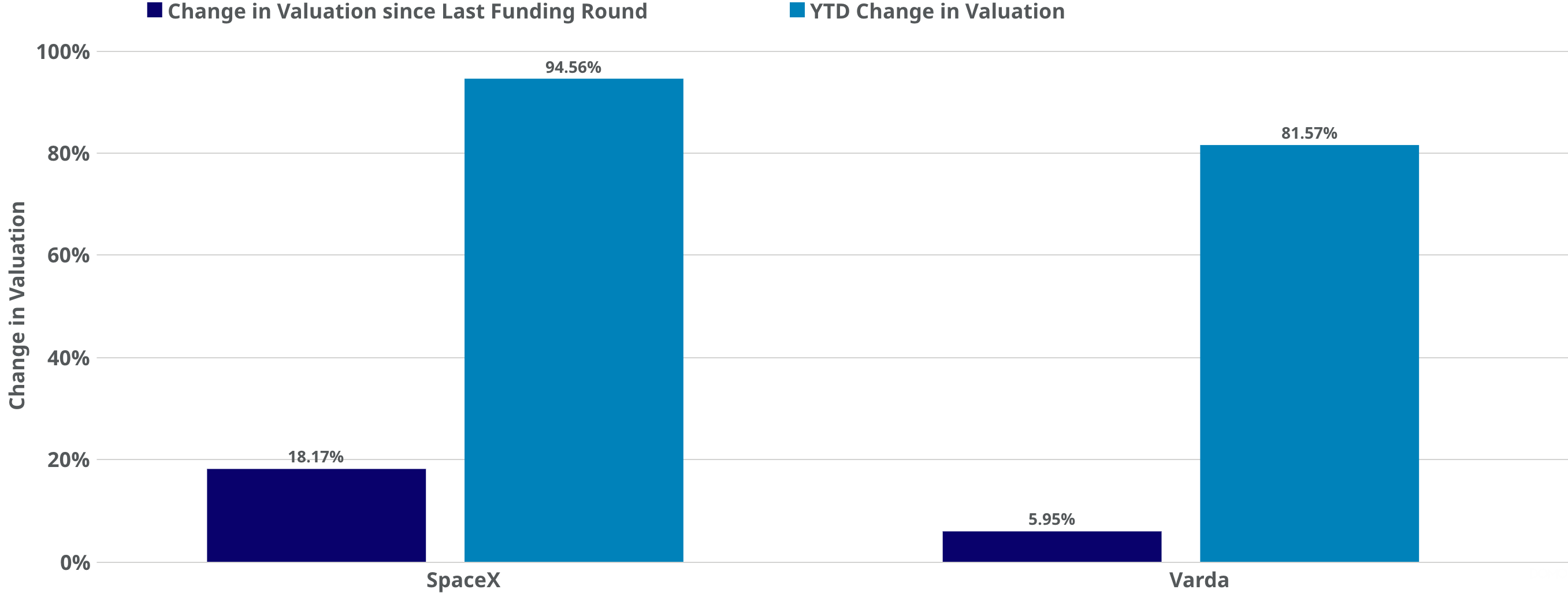
MSCI Private Company Insights uses composite prices based on institutional-sized broker contributions within the last 90 days to compute implied valuations. The current implied valuations reported below were computed as of June 8, 2026, and are compared to each company's latest funding round valuation and valuation on December 31, 2025. Apex is missing from the chart below because their valuation was unavailable.
- SpaceX's current implied valuation is $1.48 trillion, an 18.17% increase from its latest valuation of $1.25 trillion. SpaceX's implied valuation was $759.0 billion on December 31, 2025.
- Varda's current implied valuation is $1.74 billion, an 5.95% increase from its latest valuation of $1.64B. Varda's implied valuation was $957.0 million on December 31, 2025.
90D Bid and Ask Volume Ratio
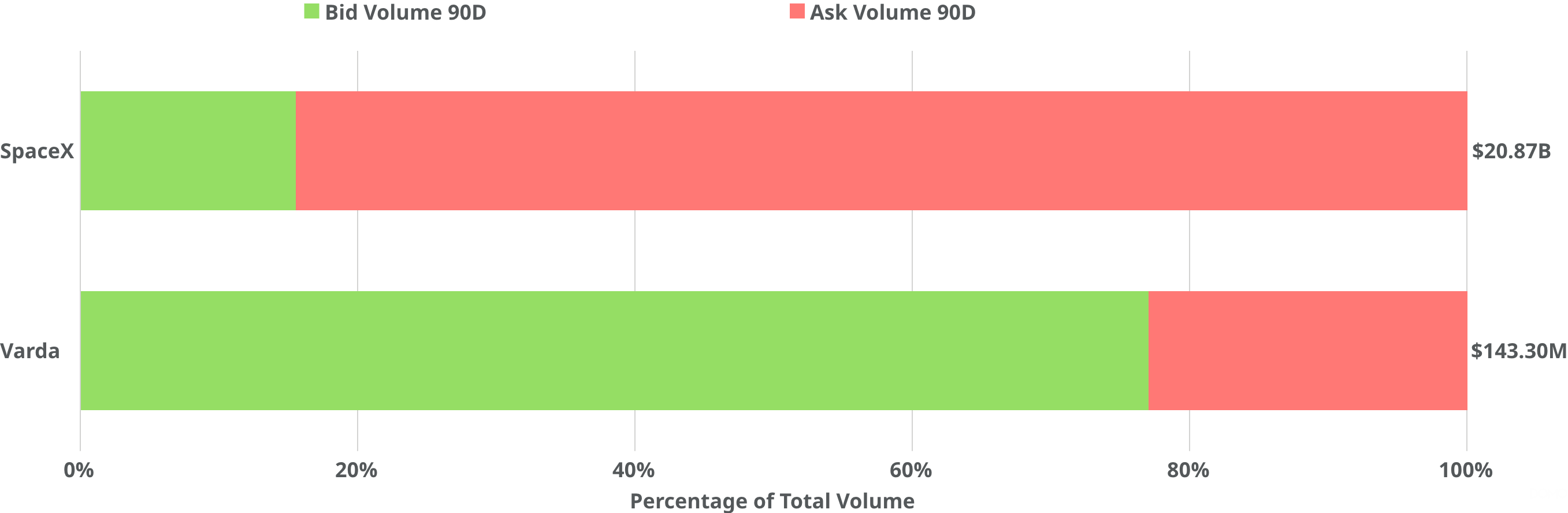
The stacked bar chart below illustrates the bid and ask volume ratios for the period from March 11, 2026, to June 8, 2026, showing only companies with at least 3 contributions. Apex is missing from the chart because their volume data was unavailable.
- Highest volume: SpaceX, $20.87 billion
- Lowest volume: Varda, $143.30 million
Change in Composite Price
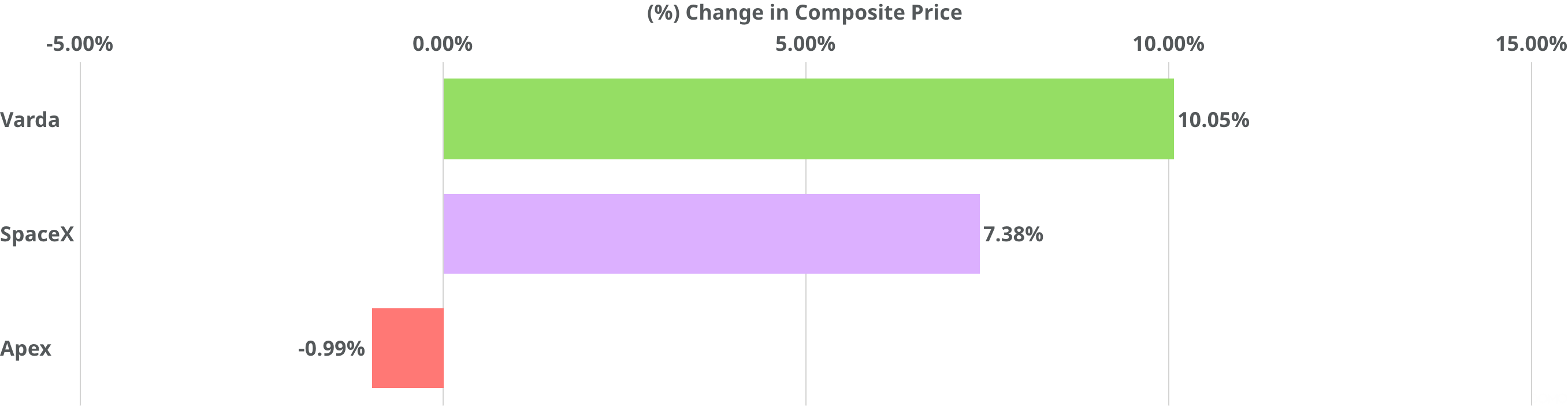
The bar chart below illustrates the 90-day change in composite prices for the period from March 11, 2026, to June 8, 2026.
- Strongest gain: Varda's composite price was up +10.05%
- Largest decline: Apex's composite price fell -0.99%
YTD Average Volatility of Composite Price
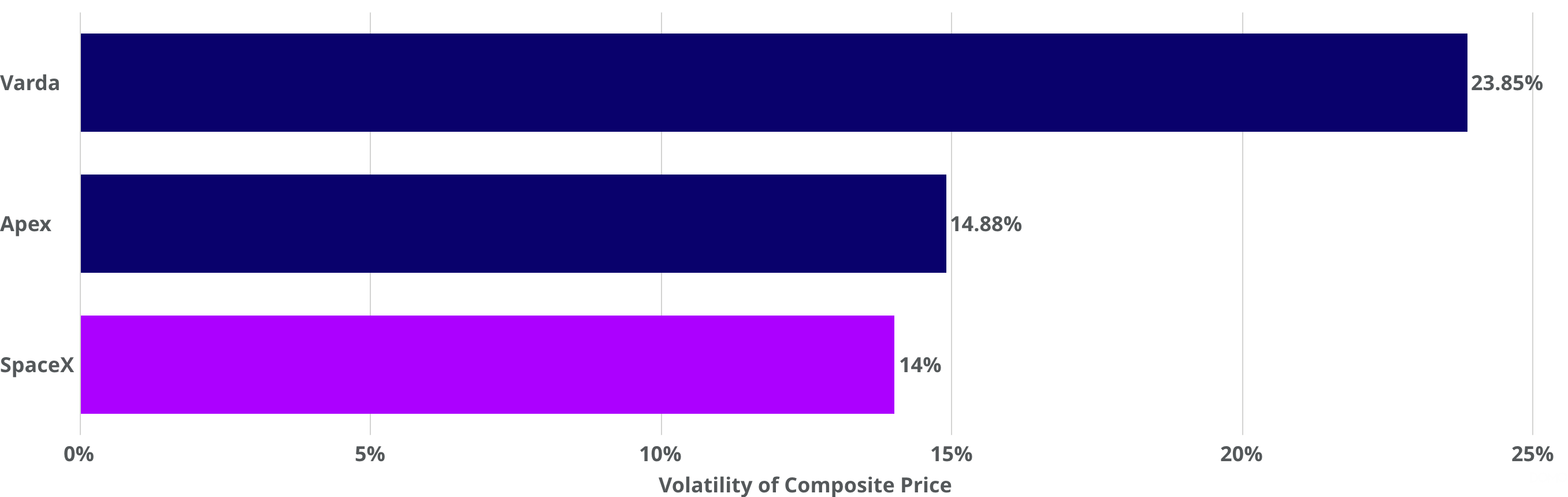
The volatility of the composite price is calculated based on price movements within a 90-day rolling window ending on that date. The bar chart below displays the mean volatility from January 1, 2026 until June 8, 2026.
- Highest Volatility: 23.85%, Varda
- Lowest Volatility: 14%, SpaceX
.png)
.jpg)
%201.png)
.jpg)
.jpg)

.jpg)
.jpg)
.jpg)
.jpg)
